
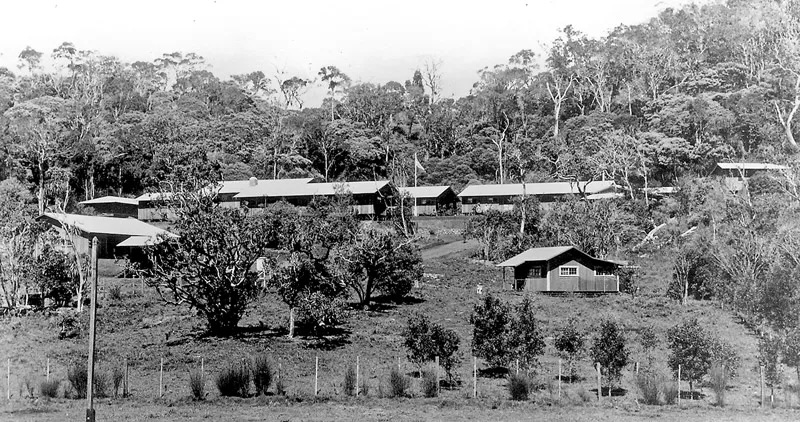
With damaged roofs, lost revenue, lingering debris and insurance questions still unresolved, Hui o Laka Executive Director Chris Faye hopes community support will help preserve one of Kauaʻi’s historic landmarks.
KŌKEʻE, KAUAʻI — More than 90 years after the Civilian Conservation Corps first established its presence in the mountains of west Kauaʻi, the historic CCC Camp is facing another chapter of restoration following Hurricane Lowell.
For Hui o Laka Executive Director Chris Faye, the immediate priorities are straightforward: replace damaged roofs and flooring, protect the historic buildings from further deterioration, and find a way to sustain the nonprofit organization until the camp can welcome visitors again.
During an Oct. 19 sit-down interview with Westside Ledger, Faye described extensive damage to the camp’s roofing, the challenges of restoring nearly century-old structures, and the financial uncertainty facing an organization that has been unable to generate its usual operating income since the September storm.
“We haven’t made a cent since September 7th, except for, you know, kind donations from people,” Faye said.
A historic landmark battered by another hurricane
Established in the 1930s under President Franklin D. Roosevelt’s New Deal, the Civilian Conservation Corps provided employment during the Great Depression while carrying out conservation and public works projects across the country.
On Kauaʻi, CCC workers helped reforest areas of Kōkeʻe, restore watersheds and improve the island’s upland landscape.
Today, the historic camp is listed on the National Register of Historic Places, and Hui o Laka continues to maintain the property as a place for educational programs, research, conservation work and community gatherings.
Hurricane Lowell was not the first powerful storm to leave its mark on the property.
Faye recalled earlier storm damage, including the destruction of the camp’s recreation hall after large cypress trees fell onto the structure.
But Lowell brought a new set of challenges.
Although none of the camp’s buildings was completely destroyed, Faye said the hurricane damaged roofing across multiple structures, including the large mess hall and two barracks.
The mess hall also lost approximately four rafters, along with roof-supporting materials that must be replaced.
“We were lucky on that,” Faye said of the fact that the camp did not lose an entire structure.
Still, the damage is significant, particularly because the buildings rely on older construction methods and materials that are not easily replaced with modern supplies.


Recovery extends beyond the camp’s buildings
The damage surrounding the historic CCC Camp is part of a much larger recovery effort unfolding throughout Kōkeʻe, where crews continue clearing fallen trees and storm debris from roadsides and surrounding properties.
In a follow-up email to Westside Ledger, Faye described the extensive work already undertaken to restore access to the upland community.
According to Faye, as many as three Kauaʻi Island Utility Cooperative (KIUC) crews were working along the highway at one point, alongside several contractors clearing both the roadway and its shoulders.
Although much of the initial highway clearing has been completed, she said crews are now working beyond the road itself, where progress remains slow.
The cleanup becomes increasingly complicated farther into Kōkeʻe, where different agencies oversee different areas.
“What we think of as Kōkeʻe comes under several jurisdictions,” Faye explained.
She noted that as the road enters Kōkeʻe State Park near mile marker 14, the number of clearing crews becomes progressively smaller.
While crews made an initial pass through the area following the hurricane, Faye said numerous driveways leading to cabins and other properties remain obstructed by piles of broken trees and debris.

The storm also dramatically altered portions of the surrounding landscape.
A photograph taken from Hui o Laka’s Director’s Cabin in the Puʻu ka Pele area shows extensive tree damage and a newly exposed view of the ocean through an area previously screened by vegetation.
The image also captures a massive redwood tree uprooted by the storm, now lying parallel to the cabin.
Together, the damaged trees, blocked driveways and continuing debris removal illustrate the challenges facing the broader Kōkeʻe community as recovery efforts continue.

Preserving history, one board at a time
Restoring the CCC Camp is not as simple as replacing damaged lumber with materials from a hardware store.
Faye explained that the dimensions of lumber used decades ago often differ from today’s standard sizes, making historically appropriate repairs more complicated and costly.
“So if you change that material, it doesn’t look right,” she said.
Maintaining the camp’s historic designation also requires careful attention to its original architectural character.
Faye said old photographs of the property have become particularly valuable because detailed construction blueprints have not been located.
“We’re very lucky we have very good photographs of the camp back in the day,” she said.
Those photographs help guide restoration work, allowing Hui o Laka to preserve the appearance of the original structures while addressing decades of wear and previous repairs.
The immediate concern, however, is preventing additional water damage.
Faye said materials for roofing repairs were expected to arrive soon, with waterproofing the buildings her first priority.
“I’m worried about the floors, because they’ve been wet for so long,” she said.
Financial losses compound the damage
Beyond the physical destruction, Hurricane Lowell has dealt a serious financial blow to Hui o Laka.
Faye said the camp has canceled approximately $30,000 in reservations through the remainder of the year.
Meanwhile, the Kōkeʻe Natural History Museum, another important part of Hui o Laka’s operations, has been unable to operate normally because of the broader closure of Kōkeʻe and the loss of essential utilities.
Faye estimated that the museum’s interrupted operations represent approximately $30,000 to $40,000 in lost monthly revenue.
Although the museum and lodge buildings escaped significant storm damage, the lack of water and electricity, along with restrictions on public access, has prevented normal operations from resuming.
The nonprofit is fully insured, Faye said, but was still waiting for information from its insurer at the time of the interview.
That uncertainty has complicated efforts to determine the organization’s financial shortfall and pursue additional disaster assistance.
“The hard part is how long can we sustain ourselves with nothing?” Faye said.
Hui o Laka is also seeking a $5,000 recovery grant through assistance efforts Faye discussed involving the Chamber of Commerce and Kauaʻi Economic Development Board.
Faye acknowledged that the grant would cover only a small portion of the organization’s overall needs, but said any financial assistance would help.
The organization also lost furniture and dining room tables, adding to the costs of eventually reopening the camp.
A call for community support
While insurance and grant funding remain uncertain, Faye is hoping the community will help bridge the gap.
“Donate, donate, donate,” she said when asked what Hui o Laka needs most from supporters.
Faye said contributions have already arrived from members, residents and people who recognize the importance of the camp’s preservation.
“Every little $15, $20 helps,” she said.
The organization recently launched an Instagram account for the CCC Camp, an effort led by one of Faye’s staff members to increase awareness of the property and its recovery needs.
Volunteer opportunities are also expected to become available once the damaged roofs are repaired and the buildings are safe for additional restoration work.
Faye anticipates that painting and other labor-intensive projects will require community assistance.
“We’ll probably just start to promote some work days and things like that,” she said.
For residents interested in helping restore Kōkeʻe’s broader trail system, Faye also pointed to the Hawaiʻi Department of Land and Natural Resources’ Nā Ala Hele Trail and Access Program, which coordinates volunteer trail maintenance activities.
However, whether volunteer trail-clearing opportunities are currently available following Hurricane Lowell has not been confirmed.
For now, the CCC Camp’s roofs must come first.
Twelve years of dedication to Kōkeʻe
Faye, whose great grandfather was the nephew of Valdemar Knudsen, has served as Hui o Laka’s executive director since 2014.
Her connection to the organization extends beyond her professional role. She said members of her extended family were involved in Hui o Laka’s early history.
Asked about her dedication to keeping the organization operating, Faye offered a characteristically straightforward explanation.
“I think I’m more stubborn, you know, stubborn to the extent that I’m trying to keep it all going,” she said.
The organization’s remote location makes attracting volunteers and maintaining financial support particularly challenging.
Yet its mission remains closely tied to the community.
In addition to the museum, Hui o Laka provides a space for nonprofit organizations, university researchers, school groups and conservation programs that might otherwise lack access to facilities in Kōkeʻe.
Faye said university classes regularly use the camp for research and educational activities, while other groups return year after year.
For her, seeing those groups use the historic buildings in ways that reflect the camp’s original conservation mission is especially meaningful.
“It just made me feel good that people are still … giving back to our community while using the camp,” she said.
Hoping for a fresh start in January
Faye hopes the CCC Camp can reopen by Jan. 1, 2027, although the timeline depends on repairs, utility restoration and access to Kōkeʻe.
With reservations already canceled through December, reopening at the beginning of the new year would offer an opportunity to begin rebuilding the organization’s operating income.
“I’d like to get reopened at least in time for January 1st,” she said.
But the goal is about more than reopening a lodging facility.
Faye wants the buildings restored, structurally sound and safe for the groups that depend on them.
“I just want them to be solid again and safe for people to stay in,” she said.
For an organization dedicated to preserving Kōkeʻe’s history and natural environment, the recovery represents another opportunity to carry forward the work of those who came before.
And as Hui o Laka waits for insurance decisions, replacement materials and the restoration of essential services, Faye hopes the community will continue standing behind the historic camp.
After nearly a century in the mountains of west Kauaʻi, the CCC Camp’s future remains closely tied to the same spirit of conservation and collective effort that helped establish it.
How to help Hui o Laka
Residents and visitors wishing to support the recovery of the historic CCC Camp can make donations through www.kokee.org.
Hui o Laka also welcomes continued memberships and anticipates organizing volunteer workdays once roofing repairs are completed and the property is ready for additional restoration efforts.
The CCC Camp’s newly launched Instagram account will provide another avenue for sharing updates and connecting with supporters.